


- You are here:
-
Sights by Regions

-
Kharkiv region
-
Kharkiv
- Botanical garden «Sarzhyn Yar», Kharkiv
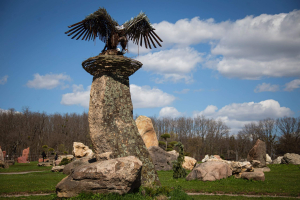
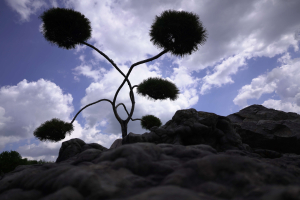
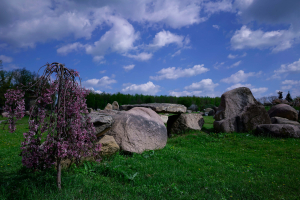
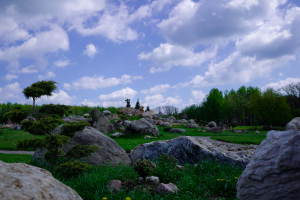
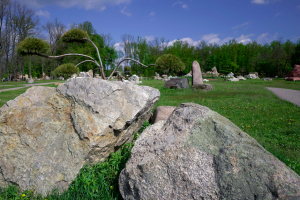
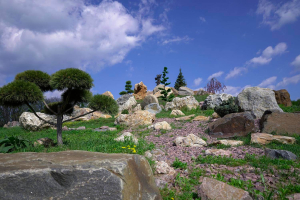
Ten generations back, more than a thousand people stand behind you. An entire attraction near Kharkiv is dedicated to exactly that feeling — the connection to those who came before us.
Among the green landscapes of Feldman Ecopark lies a remarkable spot — the Stone Park — Parents’ Park, also known as the park of a thousand stones. Its unique atmosphere has earned it a nickname from visitors: the Kharkiv Stonehenge.
Location at a Glance
| Location | within Feldman Ecopark, Lisne settlement, Kyivske Highway, 12 (north of Kharkiv) |
| What it is | Ukraine’s largest megalith park, the «Kharkiv Stonehenge» |
| Established | from 2023 |
| Admission | free entry (included in the ecopark) |
| Time needed | 30–60 minutes as part of a walk through the park |
| What to bring | comfortable shoes, a camera, and a little time for reflection |
What It Is and Why Visit
The Stone Park is an open-air natural gallery: hundreds of boulders brought from all corners of Ukraine are arranged among grass, trees, and garden spaces. This is not a museum behind glass or an archaeological monument — you can walk around the stones, study them up close, and touch them.
People come here for two things. First, for the scale and beauty of a collection millions of years in the making. Second — for the silence and the mood: the space is designed as a place for calm and reflection on family and roots.
History and Idea
Work on the Stone Park began in 2023 — a difficult time for the country, when the value of home, family, and one’s own roots was felt with particular sharpness. That is when the idea was born for a space that combines the power of nature with the memory of generations.
The stones were gathered from regions across Ukraine. Natural boulders arrived from Zakarpattia, Lviv Oblast, Ternopil Oblast, Vinnytsia Oblast, Chernihiv Oblast, Khmelnytskyi Oblast, Zhytomyr Oblast, Dnipropetrovsk Oblast, and Kryvyi Rih. Each stone has its own character — from modest specimens weighing a few kilograms to true giants. One of the park’s largest granite boulders weighs around 34 tonnes.
Stones were brought from across Ukraine — from Zakarpattia in the west to Kryvyi Rih in the east. In this way the Stone Park became a kind of stone map of the country, where nature and time have united in a single space.
What to See Up Close
The collection is striking in its variety of rock types. You can see granite, marble, quartzite, basalt, sandstone, coquina (shell limestone), and other rocks — stones that nature shaped over millions of years. Water, wind, temperature swings, and sunlight gradually carved their forms, leaving their own story on each surface.
Some of those stories are literally visible. Sandstone sometimes preserves impressions of ancient plants — the outlines of leaves and branches that survived entire geological epochs. Coquina reveals fragments of shells, while granite, thanks to its natural mineral inclusions, sometimes catches the sunlight with a gentle gleam.
Today the stones sit naturally within the park’s landscape, forming organic compositions among grass, trees, and garden spaces. In the raking light of morning or evening these compositions look their most dramatic — and that is when you’ll get the best shots.
Why It Is the Parents’ Park
But the main value of this place lies not only in its scale or beauty. The Stone Park — Parents’ Park is dedicated to our parents, our ancestors, and the unbroken continuity between generations. The stones here have become symbols of resilience, memory, and family roots.
Behind every person stands an entire family story. Two parents, four grandparents, eight great-grandparents — and with each generation the chain grows longer.
Just ten generations back, more than a thousand people stand behind us — people whose fates, choices, and lives ultimately became part of our own story.
That is why this space is designed as a place for calm and reflection. You can stroll among stones from different regions of Ukraine, spend time with loved ones, or quietly turn your thoughts to those who came before you. The Stone Park reminds us of something important: our roots are a strength that quietly sustains us every day.
How to Get There
The Stone Park is located within Feldman Ecopark, so getting here means getting to the ecopark itself.
By public transport. From Barabashovo and Derzhprom metro stations there is a free park shuttle bus, minibus route No. 159, or direct bus No. 259 — around 30 minutes’ ride.
By car. From central Kharkiv, head north along Kyivske Highway to Lisne settlement — roughly 20–30 minutes in normal traffic. Parking is available on site.
For more about the ecopark itself, its residents, and the animal rescue centre, read our article on Feldman Ecopark.
A note on safety. Kharkiv Oblast is a frontline region and the park has periodically come under attack. Check the schedule on the official pages before your trip and do not ignore air-raid alerts on site.
Visitor Checklist
What to bring:
- Comfortable shoes — exploring the stones pairs naturally with a walk through the whole ecopark.
- A camera or phone — the stones are photogenic in raking light.
- Water and cash — for coffee and a donation to the fund that maintains the park.
- A charged phone with an air-raid alert app — the region is close to the front.
What not to do:
- Do not climb on the large boulders — this is a meaningful composition, not a climbing frame.
- Do not plan your trip blindly: check first that the ecopark is open on the day you intend to visit.
Frequently Asked Questions
What is the Stone Park at Feldman Ecopark?
It is Ukraine’s largest megalith park — a collection of hundreds of natural boulders brought from different regions of the country. The attraction was created from 2023 and is dedicated to the theme of family and generational continuity, which is why its full name is Stone Park — Parents’ Park.
Why is it called the Kharkiv Stonehenge?
Because of its special atmosphere: large stones arranged among greenery remind visitors of the famous megalithic complex. It is a folk nickname, not an archaeological comparison.
How much does entry cost?
Admission is free — the Stone Park is part of Feldman Ecopark, a charitable project. You can support the park by donating to the fund.
How do I get there?
The Stone Park is located on the grounds of Feldman Ecopark in Lisne settlement near Kharkiv. From Barabashovo and Derzhprom metro stations there is a free park shuttle bus, minibus route No. 159, or direct bus No. 259.
How much time should I allow?
The attraction itself can be toured in 30–60 minutes, but it makes sense to combine it with a walk around the whole ecopark — in that case allow a few hours.
Is it worth visiting with children?
Yes. Children treat the large stones of different shapes and colours as a natural maze, and the rest of the ecopark with its animals is right next door.
The Stone Park — Parents’ Park reminds us of something important: our roots are a strength that quietly sustains us every day.
Thousands of tonnes of granite, marble, and sandstone gathered from across the country to say one simple thing: you did not come from nowhere. When you visit Feldman Ecopark, leave at least half an hour of quiet for this spot.
JoomShopping Download & Support