


- You are here:
-
Sights by Regions

-
Dnipropetrovsk region
- Dnipro (Dnipropetrovsk)
Dnipro (Dnipropetrovsk)



Imagine a city that was literally kept off tourist maps for decades. Dnipro was a closed city: rockets were built here, and outsiders were not allowed in. The city learned to live for itself, with no thought of visitors — and that is precisely why it feels so authentic, so free of the «polished for tourists» veneer.
Dnipro also defies every cliché about the «industrial east.» Yes, there is steel, there are rockets, and there is the longest riverfront promenade in Europe. But there is also one of the most beautiful riverside panoramas in the country, an island steeped in monastic legend, an Empire-style historic core, and a restaurant scene that the rest of Ukraine quietly envies. Here is where to start.
Important. Dnipro is a major rear-area city that also periodically comes under missile and drone strikes targeting residential and civilian infrastructure. The city operates normally, but any trip requires careful planning: monitor air-raid alerts via the official «Air Alarm» app and know the nearest shelters before you arrive.
City at a glance
| Founded | 1776 (as Katerynoslav); on the site of the Polovytsia settlement. Names: Katerynoslav → Dnipropetrovsk (1926) → Dnipro (2016) |
| Status | Regional capital of Dnipropetrovsk Oblast; one of Ukraine’s largest cities |
| Historic region | Prydniprovya; lands of historic Zaporizhzhia |
| Population | ~1 million |
| Area | ~410 km2 |
| Main river | Dnipro River (Europe’s longest urban embankment — ~23 km) |
| Nicknames | Rocket (space) capital of Ukraine; former «closed city» |
| Best time to visit | Year-round, subject to the security situation. May and September are ideal for the riverfront and parks |
In this article
- What kind of city is this, and why visit?
- Location and city character
- History in brief
- Legends and local lore
- Top attractions in Dnipro
- City itineraries
- Must-do experiences
- FAQ
What kind of city is this, and why visit?
Dnipro is a city-engine. It has always produced something — steel, rockets, energy, wealth. That shapes its character: direct, no-nonsense, free of sentimentality, yet surprisingly warm-hearted. Dnipro does not try to charm you into loving it — it simply works, and you either match its rhythm or you don’t.
People come here for the river. The city sits on the Dnipro River in such a way that water has become the main protagonist: 23 kilometres of embankment, an island in the middle of the city, bridges, and views worth a dedicated trip. Few major Ukrainian cities look at their river as intently as this one does.
They also come for the surprises: the rocket-and-space heritage of a once-secret city; the stone Polovtsian babas (ancient steppe figures, some over a thousand years old) standing in the courtyard of the Yavornytsky Museum; the Empire-style civic core designed as the «third capital of the empire.» And since 2022, Dnipro has become the beating rear-area heart of eastern Ukraine — supplies flow through it, wounded are treated here, logistics run from here.
Location and city character
The city straddles both banks of the Dnipro River at the point where it sweeps into a wide arc. The right bank is high, hilly, and historic — Empire-style centre, the main boulevard, parks, and museums. The left bank is flat, broader, and largely residential and industrial. Between them lies Monastyrskyi Island (Monastery Island), a green sliver of land right across from the city centre.
The city’s main axis is a long central boulevard that runs straight through the right bank. Parallel to it stretches the embankment — Europe’s longest. The centre is not «compact»; distances are large, so combining walks with public transport is the practical approach.
When to go. May and September are the most comfortable months — warm weather, the riverfront and parks at their best, without July’s heat. Summer can be hot; the river and shaded parks are the remedy. Autumn turns the city golden; winter is quieter but never closed — museums, theatres, and restaurants keep running. At any time of year, plan your visit with the security situation in mind.
History in brief
Katerynoslav
The city was founded in 1776 on the site of a Cossack-peasant settlement called Polovytsia and named Katerynoslav — in honour of Empress Catherine II. The ambition was grand: a «third capital of the empire,» complete with an Empire-style centre and a monumental cathedral. Reality came out more modest than the blueprint, but the city acquired its characteristic straight grid plan and wide central boulevard. By the nineteenth century Katerynoslav had become one of the engines of industrialisation: steel, railways, factories.
The closed rocket city
In 1926 the city was renamed Dnipropetrovsk. The real turning point came after World War II: the Yuzhnoye Machine-Building Plant (Pivdenmash / Yuzmash) opened here and became one of the foundations of the Soviet rocket-and-space programme. Because of classified production the city was declared a closed city — no foreigners were permitted until 1987. A whole generation of Dnipro residents grew up in a city that formally did not «exist» on tourist maps.
Dnipro today
In 2016, as part of Ukraine’s decommunisation process, the city reclaimed its short name — Dnipro. After Russia’s full-scale invasion in 2022 Dnipro became one of Ukraine’s key logistics hubs: a major transport, medical, and volunteer centre for the entire east. At the same time the city has sustained missile strikes on residential districts and civilian infrastructure. Dnipro did not evacuate — it works, heals, and holds the line.
Dnipro’s riverfront embankment, stretching roughly 23 kilometres, is considered the longest in Europe. It was built on a simple idea: «the city must be able to see its river» — before the project, the bank was cut off by an industrial zone.
Legends and local lore
Dnipro does not put its legends on public display — that’s consistent with everything else about it. But the legends are there, and they are worth knowing.
1. The Apostle Andrew on Monastyrskyi Island
According to local tradition, the Apostle Andrew the First-Called, travelling along the Dnipro River, stopped on the island in the middle of the stream and planted a cross there. Later, so the story goes, a Byzantine and then a Cossack monastery stood on the island — giving it the name Monastyrskyi (Monastery Island). Hard evidence is scarce, but residents hold on to the legend: it connects a relatively young city to a very ancient history.
2. The cathedral that was to be the largest in the world
When Katerynoslav was being founded, the Transfiguration Cathedral was conceived as something grandiose — legend has it that it was meant to surpass St Peter’s Basilica in Rome «by at least one arshin.» Catherine II herself laid the first stone. But money and political will stretched only to a handsome, perfectly earthly-sized church, not the «world’s largest.» Dnipro residents love this story as a metaphor: the city was always promised more than it received — and it survived anyway.
3. The city that was not on the map
The most recent Dnipro legend is about Dnipro itself. Because of the secret Yuzmash plant, the city spent decades as a closed city: no foreigners were shown it, rocket production was never mentioned aloud, and locals joked that they lived in a «ghost city.» This gave the city a particular identity: Dnipro learned to rely only on itself.
4. The orchards of Lazar Hloba
According to tradition, even before the city’s official founding, a Zaporozhian Cossack named Lazar Hloba planted orchards on these hills. Those orchards eventually grew into the city’s central parks — one of which still bears his name. Legend or fact, the image of a Cossack gardener who planted trees long before the «official» city existed appeals to locals: it makes Dnipro older than its birth certificate.
Top attractions in Dnipro
Dnipro Embankment
The city’s greatest pride and Europe’s longest riverfront promenade — roughly 23 kilometres along the river. It is not one continuous walkway but a whole system: here a wide boulevard with a cycle path, there a beach, elsewhere a park. Walking the embankment is the single best way to feel the scale and pulse of Dnipro. Dnipro Embankment does not yet have its own dedicated page on the site.
Monastyrskyi Island
A green island directly opposite the city centre, connected to the bank by a pedestrian bridge. It has a park, a church, river viewpoints, and the legend of the Apostle Andrew. In summer it serves as a city beach and favourite stroll; year-round it offers the best view of the Dnipro River from within the city. Monastyrskyi Island does not yet have its own page on the site.
Lazar Hloba Park
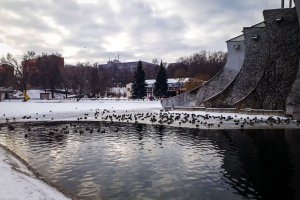
The oldest and most atmospheric park in the city — the very one that grew from Cossack orchards. Century-old plane trees, a swan pond, shaded alleys. This is the green heart of old Katerynoslav and a beloved walking spot for generations of Dnipro residents. Explore Lazar Hloba Park.
Technical Museum «Machines of Time»
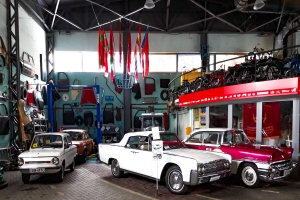
Ukraine’s largest collection of vintage cars and machinery — from pre-war models to Soviet classics, all in excellent condition. A museum that draws in car enthusiasts, children, and people who «just dropped by» equally. One of the city’s best family destinations. Explore the «Machines of Time» Museum.
Transfiguration Cathedral. The main church of the historic centre — a Classicist cathedral whose first stone, by legend, was laid by Catherine II herself. The one that was meant to be the «largest in the world» and became simply beautiful instead. Not yet covered on the site as a separate page.
Yavornytsky National History Museum. One of the finest museums in the country, named after the leading historian of Zaporozhian Cossackdom. Its signature piece: a courtyard full of stone «babas» — ancient steppe sculptures dating back thousands of years. Not yet covered on the site.
Menorah Centre and Golden Rose Synagogue. One of the world’s largest Jewish community centres — a complex of seven tower-«candles» surrounding a historic synagogue. A reminder that Dnipro has always been a multicultural city. Not yet covered on the site.
Main Boulevard and Empire-style centre. The long central boulevard with Classicist facades, squares, and pocket gardens — the same regular grid laid out for the imagined «third capital of the empire.» Best appreciated on foot. Not yet covered on the site.
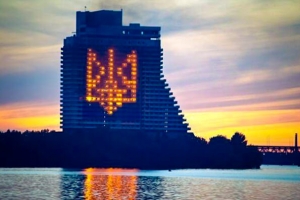
Abandoned Hotel «Parus» (Sail). An unfinished Soviet sail-shaped hotel right on the embankment — a cult object for urban-exploration enthusiasts and one of the most recognisable silhouettes in the city. Explore the abandoned «Parus» hotel.
Rocket-and-space heritage. Dnipro is Ukraine’s space capital: Yuzmash operates here; rockets that launched satellites into orbit were designed here. The theme runs through the city’s museums and its very identity. No dedicated page on the site yet.
Remains of Kodatska Fortress. On the city’s outskirts, in Stari Kodaky — ruins of a seventeenth-century fort built by the Poles to control the Zaporozhian Cossacks. The Cossacks, of course, took it. Not yet covered on the site.
City itineraries
Itinerary 1. Dnipro in one day (must-see essentials)
Start at the Empire-style centre and Transfiguration Cathedral. Continue to Lazar Hloba Park, then descend to the embankment. Walk the riverfront to Monastyrskyi Island for lunch by the water. Afternoon — Yavornytsky History Museum with its stone babas; at sunset — the silhouette of the abandoned «Parus» hotel on the embankment.
Itinerary 2. Dnipro in two days (full experience)
Day 1 — as in Itinerary 1: city centre, Lazar Hloba Park, embankment, Monastyrskyi Island, Yavornytsky Museum. Day 2 — deeper Dnipro: «Machines of Time» Museum, Menorah Centre, the city’s rocket-and-space heritage, and an evening on one of the restaurant streets.
Itinerary 3. Space and Industrial Dnipro
For visitors drawn by what the city actually does for a living: Yuzmash rocket-and-space heritage → «Machines of Time» Museum → ruins of Kodatska Fortress on the outskirts. Dnipro as a city that has always built things.
Itinerary 4. Dnipro with kids
«Machines of Time» Museum with real vintage cars → Lazar Hloba Park with swans → Monastyrskyi Island with a beach and room to run → a walk along the embankment. Plenty of fresh air and no museum boredom.
Itinerary 5. Urban exploration and the riverfront
For lovers of atmospheric off-the-beaten-path finds: abandoned «Parus» hotel on the embankment → a walk along the river past industrial landscapes → Monastyrskyi Island at sunset. A route through the unpolished side of Dnipro.
Must-do experiences
- Walk at least part of the 23-kilometre embankment — Europe’s longest. The full stretch is a full-day challenge.
- Cross the pedestrian bridge to Monastyrskyi Island and see the city from the water.
- Stand among the stone babas in the courtyard of the Yavornytsky Museum — these ancient steppe sculptures are thousands of years old.
- Wander through Lazar Hloba Park — the very one that grew from Cossack orchards.
- Marvel at the vintage cars in «Machines of Time» — the largest such collection in the country.
- Photograph the «Parus» silhouette at sunset — the city’s most iconic unfinished landmark.
- Take in the Menorah Centre — seven tower-«candles» that remind you how multicultural Dnipro has always been.
- Try Dnipro-style borscht with pampushky (garlic buns) — the local borscht tradition is worth a trip in itself.
- Dine on one of the restaurant streets in the centre — Dnipro’s food scene is genuinely one of Ukraine’s strongest.
- Stroll the main boulevard — to feel the sweep of the ambition behind the «third capital» plan.
- Pick up a rocket-themed souvenir — the honest symbol of Ukraine’s space capital.
- Watch the sunset over the Dnipro River — best from Monastyrskyi Island or the embankment.
Until 1987 Dnipro (then Dnipropetrovsk) was a closed city: because of its classified rocket industry foreigners were barred entry, and the city effectively «did not exist» for outside tourism. Its entire tourist history is younger than most of its residents.
Frequently asked questions
Is Dnipro safe to visit right now?
Dnipro is a major rear-area city that operates normally — transport, museums, restaurants, and business are all running. At the same time it periodically sustains missile and drone strikes on residential and civilian infrastructure. Plan your trip consciously: follow current advisories, respond to air-raid alerts via the official «Air Alarm» app, and locate the nearest shelters before you go.
What to see in Dnipro in one day?
The classic loop: Empire-style centre and Transfiguration Cathedral → Lazar Hloba Park → embankment and Monastyrskyi Island → Yavornytsky History Museum.
What to see in Dnipro in two days?
Day one — city centre, Lazar Hloba Park, embankment, Monastyrskyi Island, Yavornytsky Museum. Day two — «Machines of Time» Museum, Menorah Centre, rocket-and-space heritage, and an evening in the centre.
What to do in Dnipro in the evening?
Head to the embankment for river views, then on to one of the restaurant streets in the centre — Dnipro’s gastro scene is one of Ukraine’s strongest. Theatres and concert halls are also open, subject to the security situation and curfew.
What to do in Dnipro with kids?
«Machines of Time» Museum with real vintage cars, Lazar Hloba Park with swans, Monastyrskyi Island, and a walk along the embankment.
Why is Dnipro called Ukraine’s space capital?
Because the Yuzhnoye Machine-Building Plant (Yuzmash / Pivdenmash) operates here — one of the key enterprises of the rocket-and-space industry. Because of its classified production the city was closed to foreigners for decades. The space theme is still very much part of Dnipro’s identity.
What are Dnipro’s most famous dishes?
Dnipro-style borscht with pampushky (garlic buns), Cossack kulish millet porridge, steppe pancakes with sour cream, and cherry varenyky (dumplings). The city also boasts one of Ukraine’s strongest restaurant scenes, with excellent modern Ukrainian cuisine.
What to bring back from Dnipro?
Souvenirs with rocket-and-space imagery (the city’s honest symbol), handmade crafts from local workshops, local coffee and confectionery, postcards featuring the embankment and the «Parus» silhouette.
Dnipro is a city that resists a single label. Industrial — and green. Closed yesterday — and open today. Young on paper — and connected to very ancient stories through its island and its river. You don’t skim it — you come to know it slowly.
If you’re not sure where to begin, start at the embankment. In Dnipro, every road eventually leads to the river, and the river explains this city better than anything else.
JoomShopping Download & Support