


- You are here:
-
Sights by Regions

-
Dnipropetrovsk region
-
Kamianske (Dniprodzerzhynsk)
- Rosary, Kamianske
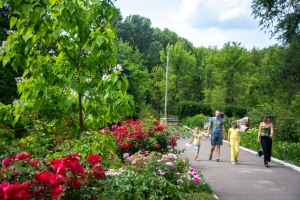

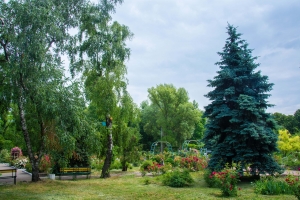

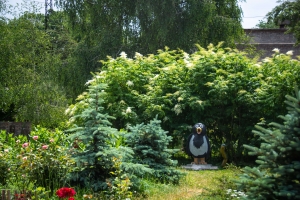


In a city of chemical giants, amid smokestacks and factory blocks, someone decided to plant roses. Not a flower bed — a full rose garden with more than two hundred varieties. And not merely for beauty, but as a living tribute to those who never came home from the war.
Location card
| Location | Kamianske, Dnipropetrovsk region |
| Founded | 1975 |
| Time needed | 30–45 minutes |
| What to bring | a camera, time for a quiet stroll — best visited during flowering season |
What it is and why people come here
The Kamianske rose garden was conceived not just as a city adornment but as a memorial. At its peak, the collection held more than 200 rose varieties, alongside rare and ornamental plants brought from across the former Soviet Union.
Visitors come for the quiet beauty in the middle of an industrial city — and for the history the garden carries within it.
History
The garden was established in 1975 on the initiative of chief city architect Valentyna Matchyna. The idea was born in the lead-up to the 30th anniversary of victory over Nazism — a living tribute to the fallen. The local Azot chemical plant still employed many war veterans and home-front workers at the time, and they wanted the honour paid to heroes to be something more than formality.
The garden was conceived as a space that would speak of the past through beauty, not through a granite slab and an inscription. Using Matchyna’s connections, the collection was enriched with rare plants from Crimea, the Carpathians, the Baltic states and the Nikitsky Botanical Garden — forsythia, tree peonies, anemones, tamarisk.
In its heyday the garden grew more than 200 rose varieties — a whole geography assembled in a single city park.
Today the garden faces the risk of neglect: DniproAzot, the enterprise that cared for it for decades, can no longer afford to maintain it from its own funds due to economic difficulties.
Stories of the garden
1. A rose «with an address»
Old-timers say that individual bushes in the garden were «assigned» to specific people — planted in someone’s honour and tended by those who remembered them. Documentary evidence is thin, but the tradition itself makes the rose garden feel less like a flower bed and more like a living monument.
2. The scent that held the city
On flowering days, the fragrance of roses drifted far beyond the garden’s boundaries — people say it could be caught on neighbouring streets even with the industrial zone close by. In a city built on chemistry, this felt like a small triumph: here the smell of flowers won out over the smell of the plant.
What to see on site
The rose collection. Even in its current state, the garden retains a wide range of varieties — during flowering season this is the main reason to make the trip.
Rare plants. Forsythia, tree peonies, tamarisk and other species brought from afar that have survived for decades.
The memorial character of the place. Read the rose garden as a monument: it is a garden of dedication, not simply a green space.
Getting there
By car. Kamianske is in Dnipropetrovsk region, north-west of Dnipro, on the banks of the Dnipro River. The rose garden is within the city limits.
By public transport. Trains and buses serve Kamianske; within the city, minibuses and trolleybuses run regularly. Ask locally for the exact route to the garden.
Tip. The best time to visit is the rose flowering season — from late spring to mid-summer.
Traveller’s checklist
- Bring: a camera — the shots during flowering season are worth it.
- Bring: time for an unhurried walk.
- Check: the flowering season and current condition of the garden before visiting.
- Don’t: pick roses or dig up plants — the collection is already under threat.
Frequently asked questions
When is the best time to visit the rose garden?
During the rose flowering season — from late spring to mid-summer, when the garden is in full bloom.
Why is the rose garden considered a memorial?
It was planted in 1975 as a living tribute to those who died in the war. The garden was a memorial from the very beginning — one expressed in the language of flowers.
Is the garden still being maintained?
The garden faces a risk of neglect: the enterprise that maintained it for years can no longer fund its upkeep due to economic difficulties.
The Kamianske rose garden is a reminder that memory doesn’t have to be carved in stone. Sometimes it blooms, carries a scent, and comes back to life every year.
That’s exactly why this garden must not be lost: one bad year without care, and two hundred varieties of memory could disappear more quietly than a single rose withers.
JoomShopping Download & Support