

- You are here:
-
Sights by Regions

-
Chornobyl Exclusion Zone
-
Pripyat
- River port and cafe Pripyat
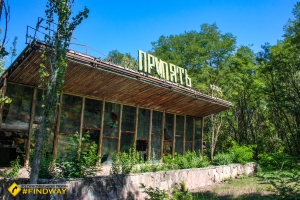
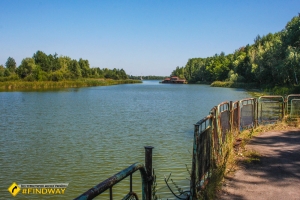


A two-hour ride on a "Raketa" hydrofoil once got you from here to Kyiv. Today this harbor is left with a concrete embankment, the skeleton of a stained-glass cafe, and a dozen rusting vessels slowly sinking into the water.
The river port was Pripyat's showpiece on the waterfront — the first thing river travelers saw as their boat approached the young atomic city. Now it's one of the quietest spots in the entire exclusion zone.
Quick Facts
| Location | Pripyat, on the bank of the Pripyat River, Chornobyl Exclusion Zone |
| Distance | ~3 km from central Pripyat, ~110 km from Kyiv |
| Time needed | 30–40 minutes |
| What to bring | A zone access permit, a dosimeter, water, sturdy boots for mud, a camera |
What it is and why visit
Pripyat's river port is an embankment with the "Pripyat" cafe, a passenger pier, and access to Yaniv Bay, where a so-called ship graveyard sits frozen nearby. In Soviet times, the city wasn't reached only by train and bus — high-speed "Raketa" and "Meteor" hydrofoils connected the young atomic city directly to Kyiv by water.
People come here for two things. First, the cafe building, with its distinctive Soviet-era design and colorful stained-glass windows — one of the city's most recognizable structures. Second, the atmosphere of frozen time: water, reeds, rusted iron, and total silence where boat engines once roared.
History
Pripyat was founded on February 4, 1970, as a city for Chornobyl Nuclear Power Plant workers. It was built from scratch and designed as a model city: wide avenues, new residential districts, and its own infrastructure. The river port and cafe were built in the mid-1970s, along with the rest of the city's public facilities.
The "Pripyat" cafe quickly became an informal hub of waterfront city life. According to local accounts, this is where construction workers celebrated the launch of the plant's first reactor unit in 1977. Inside, it featured stained glass, Polissia-inspired decor, and panoramic windows overlooking the river.
A high-speed hydrofoil could get you to Kyiv in about two hours — almost as fast as a modern highway, but with views of Polissia along the way.
Everything ended on April 26, 1986. After the accident at reactor unit four, the city was evacuated within hours, and the port emptied along with the streets. The vessels used in the cleanup — hauling gravel, concrete, and radioactive soil — were later abandoned in the neighboring bay because of contamination. That's how the "ship graveyard" next to the port came to be.
Legends and lore
The water in the exclusion zone has always grown its own folklore faster than the land around it.
1. The giant catfish
The zone's most famous tale is about giant catfish that supposedly grew enormous near the port due to the absence of fishermen and rich silt. In reality, the catfish here really are large — not because of radiation, but because no one has fished them for decades. Tourists still feed them from the embankment.
2. The ship that never fully sinks
Among the nearby vessels are barges that have stayed at the same waterline for years — never fully sinking, never resurfacing. Stalkers joke that they're "waiting for a crew that will never come back."
What to see on site
The "Pripyat" cafe building. The main reason to come. The frame, part of the stained-glass windows, and the panoramic window openings overlooking the river all survive. Going inside is dangerous — the floors and ceilings are unstable.
The embankment and pier. Concrete slabs where the "Raketa" hydrofoils once docked. This spot offers the best view of the water and the opposite bank.
The ship graveyard. Nearby, in the bay, sit a dozen half-sunken vessels that took part in the cleanup. Each year more of them disappear under the water, so the view changes a little every season.
How to get there
Important. Pripyat is located within the Chornobyl Exclusion Zone. Independent entry is prohibited. Since 2022, access to the zone has been restricted for security reasons (military activity, mines), so check the current visiting status before planning a trip.
With an organized group. The standard route runs from Kyiv through the "Dytyatky" checkpoint, then via Chornobyl to Pripyat. The port is included in extended city tours alongside other locations.
On foot within the city. It's a few kilometers from the central square to the port, along roads being reclaimed by forest. A guide leads the group along a route that's safe in terms of radiation levels.
Traveler's checklist
- Zone access permit — you can't get here without one.
- Dosimeter — pockets of elevated radiation occur near the water and vessels.
- Closed shoes and clothing — mud, reeds, rusted metal.
- Water and snacks — there's nothing available on site.
- What NOT to do: enter the cafe building, climb onto the vessels, or touch the soil near the bay with bare hands.
Frequently asked questions
Is it safe to go there?
As part of an organized tour with a guide and a dosimeter — yes. But since 2022, access to the zone has been restricted, so check the visiting status before your trip.
Can you go inside the cafe?
No. The building is structurally unsafe, and the floors could collapse. It can only be viewed from outside.
Are there really giant catfish near the port?
Yes, the fish here are genuinely large — not because of radiation, but because no one has fished them for decades.
When's the best time to visit?
Late autumn, winter, or early spring — when there's no foliage or reeds, more of the vessels and the embankment itself are visible.
Boats once left from here for Kyiv, and the embankment smelled of diesel and the river. Now all you hear is wind through the cafe's stained glass and a quiet lapping against the half-sunken barges.
The river port shows Pripyat from an angle rarely photographed: not streets and high-rises, but water that still remembers the city when it was alive.
JoomShopping Download & Support