


- You are here:
-
Sights by Regions

-
Chornobyl Exclusion Zone
-
Pripyat
- Abandoned apartments, Pripyat

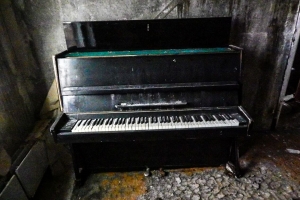


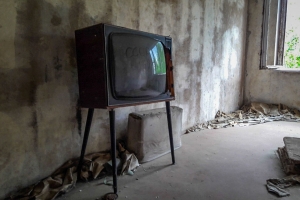

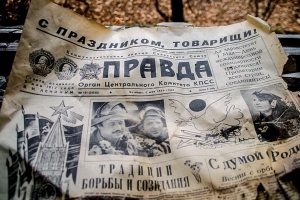

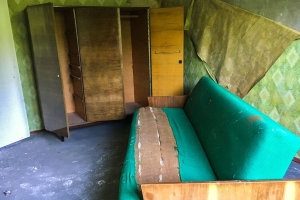
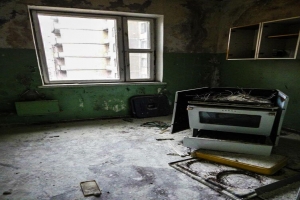
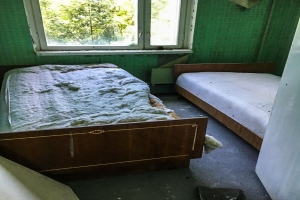
A man evacuated from Pripyat as a child on 26 April 1986 returned to his apartment nearly forty years later. The doors, the furniture, the wallpaper — nothing was as he remembered. In the decades in between, the flat had been looted, flooded by rain, and colonised by mould.
The abandoned apartments of Pripyat are not museum interiors behind glass — they are a cross-section of a life cut off mid-sentence. More than any «official» attraction, they convey what it actually means for an entire city to be emptied all at once.
Location Card
| Location | residential blocks of Pripyat, Chornobyl Exclusion Zone, Kyiv Oblast |
| What it is | abandoned flats of the Soviet nuclear satellite city |
| Abandoned | since 27 April 1986 |
| Condition | looted, derelict, many buildings structurally unsafe |
| Access | restricted territory; tourist access currently closed |
| Time needed | depends on the route; typically several buildings in sequence |
In this article
- What it is and why people come here
- History: the dream city that emptied in hours
- Legends and local lore
- What to see inside
- Getting there and access
- Traveller’s checklist
- Frequently asked questions
What it is and why people come here
These are ordinary flats in ordinary Soviet apartment blocks — just abandoned nearly forty years ago. There are no «exhibits» here: just the remnants of furniture, wallpaper, tiles, and occasional forgotten objects of everyday life that somehow hit harder than any monument.
Visitors come for the private Chornobyl, not the postcard one. The Ferris wheel on the central square is a symbol. An abandoned kitchen with faded wallpaper is something else — it’s someone specific, whose life ended here at a particular hour on a particular April day.
A word of honest warning: the romantic notion of «apartments frozen in time» with neatly made beds has almost entirely been overtaken by reality. What’s actually there is far more stripped-down — more on that below.
History: the dream city that emptied in hours
Pripyat was founded in 1970 as a model «nuclear city». Young people came from across the Soviet Union: new apartments, high salaries, hard-to-find consumer goods, swimming pools, and palaces of culture. By Soviet standards, it was close to communism «here and now».
In the early hours of 26 April 1986, it was all over. For the entire first day, residents were told nothing. On 27 April, evacuation was announced «for three days» — people were advised to take their documents and the bare minimum of belongings.
Almost 50,000 people walked out of their own apartments, locking the door «for three days.» For the vast majority, those three days never ended.
Why everything has been stripped
After the evacuation, the belongings of tens of thousands of families remained in the city. Over the following years, apartments were systematically looted: furniture, appliances, doors, plumbing, even radiators and wiring were stripped for scrap. What we see today is not a «preserved past» — it is the result of decades of looting, damp, and time.
Pripyat’s abandoned apartments are therefore a double story: first, of the disaster itself, and then of how people picked apart a city that no one could return to.
Legends and local lore
Pripyat’s residential blocks have accumulated their own stories — some touching, some genuinely unsettling.
1. The apartment recognised after 40 years
A documented, not invented, story: former residents sometimes return to the Zone to find their old flat. Some recognise it by a surviving tile pattern or a distinctive wallpaper print. This is Pripyat’s real «legend» — not a ghost, but a living human memory of a home that no longer exists.
2. «Someone is walking upstairs»
Stalkers (urban explorers of the Zone) report footsteps and creaking in the empty stairwells. The explanation is usually mundane: draughts, animals, settling structures. But in a faded stairwell on the ninth floor, these sounds feel entirely different.
3. The buildings returning to the forest
A «legend of the present»: trees are already growing through roofs and balconies, their roots splitting the walls. Pripyat is slowly becoming a forest with concrete skeletons — and someday the apartments will be nothing but voids in the green.
What to see inside
Remnants of everyday life. Faded wallpaper, tiles, occasional furniture fragments and small objects. It’s the details, not the «complete» rooms, that carry the atmosphere.
The view from the windows. Upper floors offer views over an overgrown Pripyat — a city being swallowed by forest. One of the most haunting images in the entire Zone.
Lobbies and stairwells. Letterboxes, graffiti, Soviet-era signs — small witnesses to a former daily life.
The whole city as context. The apartments make most sense as part of a broader walk through Pripyat. Full context is in our overview of the Chornobyl Exclusion Zone.
Getting there and access
Important. Pripyat is a restricted zone within the Chornobyl Exclusion Zone. Access is possible only on an organised tour with official authorisation and a licensed guide.
Current status. Due to the full-scale war, the temporary occupation of the Zone in early 2022, and the mining of parts of the territory, tourist access is currently closed. Note also that entering the buildings themselves was already strictly restricted before the war due to structural hazards — many are simply unsafe.
Orientation. Residential blocks are spread across the city; on a guided tour, the guide selects the relatively safer stairwells.
Traveller’s checklist
When the Zone reopens:
- Official tour and permit: non-negotiable, no exceptions.
- Dosimeter: radiation levels inside flats and stairwells are uneven.
- Sturdy shoes and a torch: broken glass, debris and dark stairwells everywhere.
- Caution on upper floors: floors, stairs and balconies may be structurally unsound.
- Respect: these were people’s homes, not «abandoned loot» — take nothing away.
What NOT to do: use damaged stairwells, wander alone off the route, or «take a little something as a souvenir».
Frequently asked questions
Is it true that everything in the apartments is just as it was in 1986?
No. The apartments were looted for decades — furniture, appliances, even the doors were long since removed. What remains is mainly fragments of everyday objects, wallpaper, and tiles.
Why didn’t the residents take their things?
Because the evacuation was announced «for three days» — people were told to take only documents and the bare minimum. They were never allowed to return.
Can you visit now?
Not currently. Access to the Chornobyl Exclusion Zone is closed due to the war and mine contamination. Check the latest official guidance before planning.
Is it safe to enter the buildings?
Many buildings are structurally unsafe, so even on guided tours access inside is restricted. Floors, stairs and balconies can be unreliable.
The abandoned apartments of Pripyat won’t give you a beautiful, cinematic shot of untouched belongings. They’ll give you something else — the understanding that a catastrophe is measured not only in roentgens, but in the number of doors locked «for three days.»
Nearly fifty thousand such doors. And behind each one — someone’s kitchen, someone’s wallpaper, someone’s life, left behind in that April.
JoomShopping Download & Support