

- You are here:
-
Sights by Regions

-
Chornobyl Exclusion Zone
-
Pripyat
- Graffiti of Pripyat
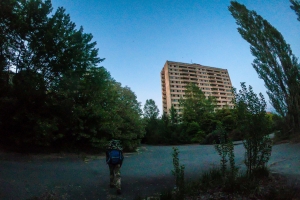

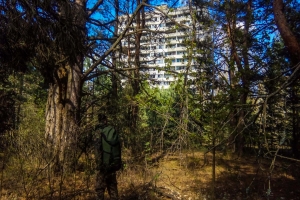


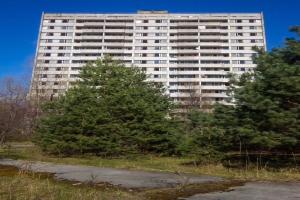
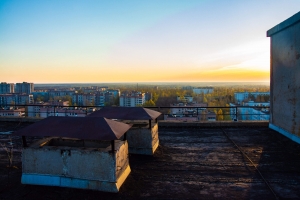

From the roof of this building you can see the entire dead city at once: the grid of residential blocks sinking into forest, the Ferris wheel, and the grey silhouette of the Chornobyl Nuclear Power Plant on the horizon. And above your head — a rusting Soviet coat of arms that outlasted the country that put it there.
The “Europa” 16-storey block is one of the tallest residential buildings in Pripyat and the classic final stop on any route — the place people climbed to for the defining view of the Chornobyl Exclusion Zone. The name is unofficial, from the vocabulary of stalkers (urban explorers); the coat of arms on the roof has made this building recognisable from thousands of photographs.
Location Card
| Location | Pripyat, Chornobyl Exclusion Zone, Kyiv Region |
| What it is | abandoned 16-storey residential block with a coat of arms on the roof |
| Famous for | panoramic view over the entire city and the ChNPP |
| Condition | structurally unsafe, ascent is dangerous |
| Access (2026) | zone closed to tourists |
What It Is and Why People Come
Pripyat was built predominantly with nine- and sixteen-storey blocks, and it is the sixteen-storey high-rises that define its skyline. Giant coats of arms — of the Ukrainian SSR or the USSR — were installed on the roofs of the most prominent ones to underline the status of this young nuclear city.
People come here for one thing: the view. From the roof, Pripyat becomes legible as a whole — the orderly residential grids swallowed by forest, the central square, the river port, and most strikingly, the silhouette of the ChNPP in the distance. This is the shot photographers endured dark stairwells and unsafe floors to get.
History
Pripyat was founded in 1970 as a workers’ city alongside the Chornobyl Nuclear Power Plant. It grew fast and «by the book»: wide boulevards, residential districts, schools, a swimming pool, a palace of culture. By 1986 some 50,000 people lived here, mostly young families — the average resident was under thirty.
The sixteen-storey buildings were erected in the later residential districts as architectural focal points. The coat of arms on the roof was not decoration but an ideological statement: the nuclear city of the future was meant to look impressive even from the air.
27 April 1986
The day after the accident, the city was evacuated in a matter of hours — residents were told they would be back in three days. Almost no one ever returned. Since then the high-rises have stood empty, slowly being consumed by vegetation, and the coats of arms on the rooftops have become unintentional monuments to a vanished era.
Legends and Atmosphere
The high-rises of a dead city are the perfect breeding ground for stories.
1. The City That Breathes
Stalkers love to describe «sounds of life» inside the high-rises — creaking, footsteps, doors slamming on upper floors. The explanation is mundane: draughts through empty buildings with broken windows set everything loose in motion. But when you are alone on the sixteenth floor, the explanation offers little comfort.
2. The Crest Nobody Would Take Down
There is a story that no one dared remove the coat of arms from the roof — perhaps because of the height and the unsafe structure, perhaps out of superstition. The real reason is simpler: in a dead city there is simply no one to do it, and no reason to. So the Soviet symbol still hangs over an empty Pripyat.
What to See on Site
The roof and the crest. The main reason to make the climb: a panoramic viewing point over the whole city, and that Soviet coat of arms up close.
The view of the ChNPP. From up here the plant is clearly visible, including the New Safe Confinement dome over the fourth reactor — a rare chance to take in the full scale in a single glance.
The abandoned flats. On the way up — typical Soviet apartments with wallpaper, tiles, and the remnants of everyday life from 1986.
The city was built for 50,000 people with an average age of around 26. Today the only «residents» of the high-rises are draughts, moss, and a coat of arms that outlived its country.
Current Status (2026)
The Chornobyl Exclusion Zone is currently closed to regular tourists. After the Russian military occupation in spring 2022, parts of the territory were mined, and the exact maps of minefields are unknown; because of this, and the proximity to the Belarusian border, tours have been suspended.
Access is currently possible only with accreditation from the Ministry of Defence or as part of official delegations. An additional note: climbing to the roof of a structurally unsafe high-rise is dangerous in itself — stairs, floor slabs, and parapets are all unreliable.
Getting There
Organised tours only. Unauthorised entry into the zone has always been prohibited. Pripyat was visited exclusively on licensed tours through the Dytyatky checkpoint with a guide.
Within the city. The high-rise was typically saved for last on the walking route — the final vantage point before departure.
Climbing safely. Sturdy footwear, a torch, no solo ascents; on the roof — keep well away from the edges and any crumbling parapets.
Visitor Checklist
- Sturdy footwear and a torch: stairwells are dark and in places blocked by debris and rubble.
- Dosimeter: radiation levels on the roof are usually lower, but hot spots can be encountered on the way up.
- Caution at the edges: parapets are unsafe and there is no safety equipment.
- What NOT to do: climb alone, sit on a parapet for a shot, or break off or take away any part of the building.
Frequently Asked Questions
Why is the building called “Europa”?
It is an unofficial stalker nickname, not a historical place name. Officially this is simply one of Pripyat’s sixteen-storey residential blocks.
Can I visit in 2026?
No. The zone is closed to tourists due to the war and landmines left after the 2022 occupation; access requires special authorisation from the Ministry of Defence.
What can you see from the roof?
All of Pripyat from above: residential blocks in the forest, the central square, the Ferris wheel, and the silhouette of the ChNPP on the horizon.
How dangerous is the climb?
Very. The building is structurally unsafe: stairs, floor slabs, and parapets are unreliable. Visits were always done as part of an organised group and entirely at your own risk.
The “Europa” block is the finest vantage point in the dead city and at the same time its most precise symbol. The Soviet coat of arms above empty Pripyat has outlasted both the people and the state — and it is from here, from the height of the sixteenth floor, that you can best see how quickly the forest takes back everything humanity managed to build.
JoomShopping Download & Support