


- You are here:
-
Sights by Regions

-
Chornobyl Exclusion Zone
- Radioactive sedimentation of vehicles «Buryakovka»


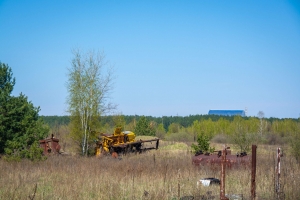

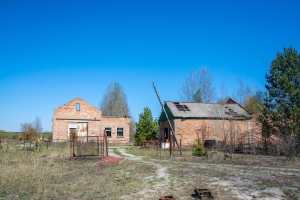
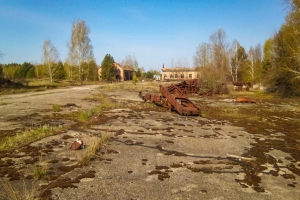


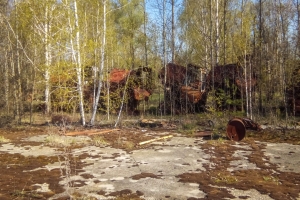
An entire village here was not abandoned — it was bulldozed into the ground. And nearby, in the weeds, tractors still rust that decades later you cannot safely touch.
The Machine Tractor Station (MTS) in Kopachi is one of the most haunting sites in the Chornobyl Exclusion Zone. These are the remnants of collective-farm machinery just four kilometres from Reactor No. 4, in a place where an entire village left nothing behind but mounds over buried houses.
Quick Facts
| Location | Kopachi village, Chornobyl Exclusion Zone, Kyiv Region |
| Distance to ChNPP | approx. 4 km (2.5 mi) |
| What it is | abandoned Soviet collective-farm machine tractor station |
| Access (2026) | zone closed to tourists |
| What to bring | dosimeter, respirator, fully covering clothing (when legal access resumes) |
What it is and why people go
A Machine Tractor Station was a Soviet «technical hub» for rural communities: the place where tractors, combine harvesters and other farm machinery were serviced and stored before being allocated to collective farms. The Kopachi MTS served the local agriculture right up to April 1986.
After the disaster, machinery that had been working the most contaminated soil became a problem in itself: it couldn’t simply be driven away and cleaned. So the MTS became what stalkers and photographers call an «equipment graveyard» — a yard where tractors and trailers rust under a radiation reading that makes your dosimeter nervous. People come here not for beauty, but to feel the scale of the catastrophe up close.
History
Before 1986 Kopachi was an ordinary large village a few kilometres from Pripyat — home to more than a thousand people, with a school, a kindergarten and a collective farm. The MTS serviced the surrounding fields.
On 26 April 1986 everything ended. Kopachi lay directly in the path of the radioactive plume, and during the clean-up it was decided not to evacuate but to destroy the village: houses were demolished and buried in place to «entomb» the radioactive dust. Today, where the streets once ran, there is a flat field with characteristic mounds and radiation-hazard signs.
Why the machinery was left behind
Farm machines that had worked contaminated soil became radiation sources themselves. Decontaminating them was expensive and often futile, so most of the equipment was simply left where it stood — in the MTS yard and around it. Decades of rust have taken their toll on the metal, but the radiation background at certain spots remains elevated.
Kopachi is one of the very few villages that after the disaster was not merely abandoned but physically buried. All that remains of an entire settlement is a kindergarten, a monument and mounds over entombed homes.
Legends & local lore
A place with this kind of history grows legends faster than it grows weeds.
1. The village that rises from the ground
Among stalkers there is a story that in spring the outlines of old foundations — and even the smell of a cellar — «seep through» above the buried Kopachi. In reality it is ordinary geology: soil settles unevenly, exposing remnants. But at night the story sounds different.
2. The «hot» tractor
Nearly every guide had a favourite exhibit — one particular machine where the dosimeter would «sing» louder than anywhere else nearby. It was presented as an attraction, the device held at arm’s length. The lesson is simple: in the Zone, danger is not the landscape in general but specific hot spots.
What to see on site
The equipment yard. Rusting tractors, trailers and farm machinery remnants — the main «exhibit» of the MTS. Metal, weeds and silence.
The field of buried Kopachi. Right next door — the flat field with mounds and radiation-hazard signs marking the site of the former village.
The Kopachi kindergarten. One of the few surviving buildings of the village nearby — with the same «staged» dolls and cots that have become an iconic symbol of the Exclusion Zone.
Current status (2026)
Important: the Chornobyl Exclusion Zone is currently closed to ordinary tourists. After Russian forces occupied the Zone in spring 2022, large parts of the territory were mined; the precise locations of minefields are unknown. For this reason, and because of the proximity to the Belarusian border, guided tours have been suspended.
Entry to the Zone is now possible only with accreditation from the Ministry of Defence or as part of official delegations. Everything in the «Getting there» section below will apply when tourism to the Zone resumes.
Getting there
Organised tours only. Independent entry into the Zone has always been prohibited — before the war and even more so now. Kopachi was visited exclusively as part of licensed tours via the Dytyatky checkpoint.
Route. The village lies on the road between Chornobyl town and the power plant, so the MTS was typically a stop on the way to the reactor and Pripyat.
Essential: dosimeter, respirator, fully covering clothing, and strict compliance with your guide’s instructions about where you may and may not stand.
Traveller’s checklist
- Dosimeter: not for the drama, but to actually know where the hot spots are.
- Fully covering clothing and footwear: no exposed skin; place nothing on the ground.
- Respirator: the main danger is dust, not «radiation» in general.
- What NOT to do: touch the machinery, sit on metal, take anything away, or leave the marked route.
Frequently asked questions
Can you visit in 2026?
No, the Zone is closed to tourists because of the war and minefields left after the 2022 occupation. Access requires special Ministry of Defence authorisation.
Why was the village buried rather than evacuated?
Kopachi lay in a heavily contaminated zone. During the clean-up, buildings were demolished and buried in place to «entomb» the radioactive dust.
How dangerous is the machinery itself?
The metal has rusted over the decades, but certain machines remain «hot.» Do not touch them or sit on them.
What else is worth seeing nearby?
Right next door is the field of buried Kopachi and the village’s famous kindergarten; further along the road lie the Chornobyl Nuclear Power Plant and Pripyat.
The Kopachi MTS is a lesson in what a disaster looks like in its details. Not the explosion or the reactor, but ordinary village machinery that could not be moved, and an entire settlement that went underground. A rusting tractor in the weeds here speaks louder than any memorial.
JoomShopping Download & Support
Attention! Part of Ukraine was occupied during Russia's unfounded military aggression against us and other democratic countries!
russia is a terrorist country, russians are murderers, thieves and rapists.
Russia's unhuman aggression against Ukraine since 2014 has led to the loss of homes and lives not only of many Ukrainians, but also of citizens of other countries and nationalities.
We consider any military actions against any state in the 21st century unacceptable and stupid, but unfortunately the Russians do not think so, and therefore many democratic countries, including Moldova, Georgia and our homeland, suffer from barbaric aggression.
Therefore, until the occupied parts of Ukraine are demilitarized and returned to our state, we remind users about the real danger of visiting the territories occupied by russia.