


- You are here:
-
Sights by Regions

-
Kirovohrad region
- Konstantinovskiy coal quarry and flooded excavators, Berezivka
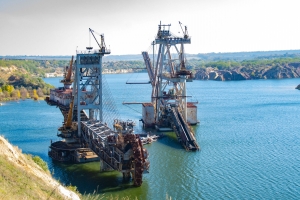
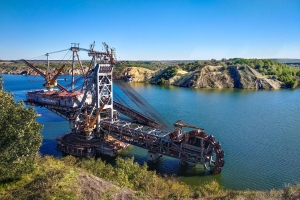

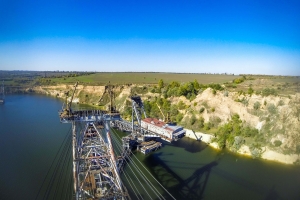
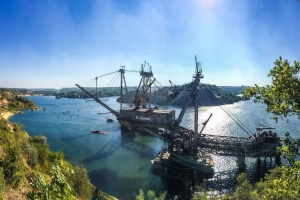

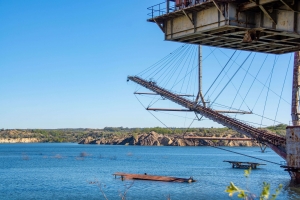
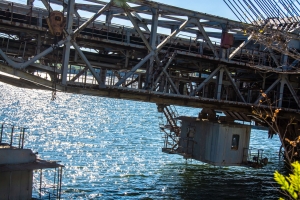
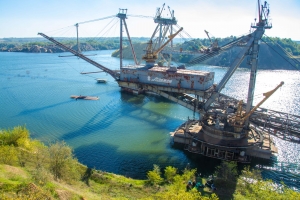
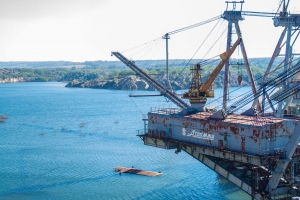

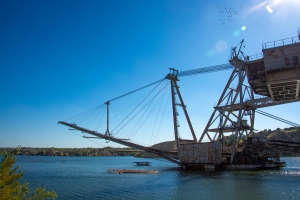
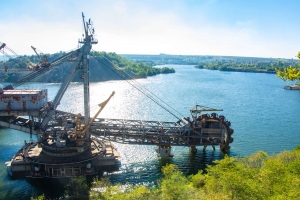
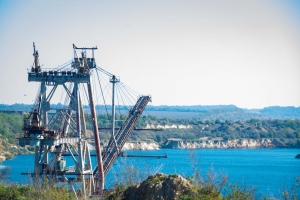
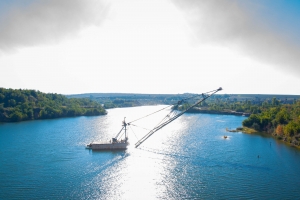
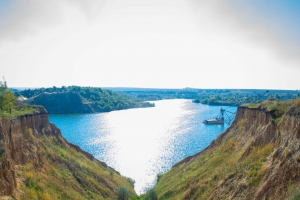
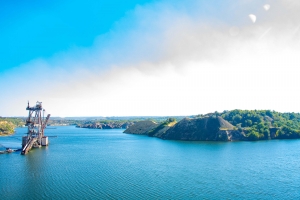
Picture an excavator as tall as a ten-storey building and as heavy as a hundred tanks. Now picture it standing motionless in the middle of a lake, only its cabin and part of the boom poking out above the water. And it has been like that for over a decade. That’s the Kostiantynivskyi open-pit coal mine in the village of Berezivka, Kirovohrad Oblast — one of Ukraine’s most surreal hidden gems.
This place is way off the beaten path. No castle, no monastery, no Cossack legends about hidden gold. Instead — a vast flooded crater, a handful of abandoned Soviet and German machines the size of buildings, and an absolute industrial silence in a place that once roared with thousands of cubic metres of coal an hour.
Quick facts
| Location | Berezivka village, Oleksandriia Raion, Kirovohrad Oblast, central Ukraine |
| Distance from Oleksandriia | ~15 km (≈ 9 mi) west |
| Years in operation | 1987–2010 |
| What to see | flooded quarry with an island, mothballed ERShRD-5250 rotor excavator, German TAKRAF chain excavator |
| Access | free, no formal security on site |
| Time to explore | 2–3 hours (preferably with a stop at the nearby Morozivskyi quarry) |
In this article
- What Kostiantynivskyi is, and why it’s worth a trip
- A short history of coal in Kirovohrad Oblast
- The monster machines: ERShRD-5250 and the German TAKRAF
- An excavator graveyard: why nobody hauled them away
- What it looks like today: a lake, an island, and silence
- What urbexers and locals say about the place
- Nearby spots: Morozivskyi quarry and Oleksandriia
- What to see on site
- How to get there
- Traveller’s checklist
- Frequently asked questions
What Kostiantynivskyi is, and why it’s worth a trip
The Kostiantynivskyi open-pit mine is an abandoned brown-coal (lignite) quarry. Don’t confuse it with a deep mine: nobody dug tunnels here. They cut down from above in massive terraced steps — like a Greek amphitheatre, only inverted. At the bottom of that amphitheatre worked machines whose dimensions your brain refuses to accept on first sight.
Today, the whole thing is a giant body of water with an island in the middle, a few excavators frozen mid-task, and an absolute, almost architectural silence. Travellers call this place an "excavator graveyard" — short, accurate, no extra words needed.
People come here for three things: the sheer scale of the machinery (you definitely don’t have anything like this on your Instagram yet), the "the world forgot about this slice of the USSR" atmosphere, and photos that look like stills from post-Soviet science fiction. If you’re into industrial ruins, abandoned giant machinery, or you simply want a location where your eyes go wide on their own — this one is for you.
A short history of coal in Kirovohrad Oblast
Kirovohrad Oblast isn’t Donbas — but it has its own coal-mining heritage. The difference: instead of hard coal, this region produced brown coal (lignite) — younger, softer, lower in calorific value. Lignite sits close to the surface, so it’s most cost-effective to scrape it out from above.
The industrial heart of the basin was the city of Oleksandriia. In 1976, the Soviet government created a state holding called Oleksandriiavuhillia ("Oleksandriia Coal") that consolidated all the mines and quarries in the area. The peak years were the mid-1970s: in 1975 alone, the basin produced 12.7 million tonnes of coal and 4.3 million tonnes of briquettes.
By 1990, Oleksandriiavuhillia employed over 20,000 people. By 2004 — only 6,000. By 2010, every single quarry had shut down. In 35 years, the entire industry shrank from a whale to a fish.
Kostiantynivskyi was the youngest of the three "Oleksandriia" quarries: it opened in 1987. The plan was simple — fresh coal seams, brand-new equipment, decades of mining ahead. At its peak, the site produced over a million tonnes of coal per year.
Then came the 1990s, and then the 2000s. Natural gas got cheaper, brown coal got cheaper still, and the economics of lignite mining quietly collapsed. In 2010, the quarry was shut down for good. Equipment that was easier to leave than dismantle — got left. The pit started filling with groundwater. It’s still filling.
The monster machines: ERShRD-5250 and the German TAKRAF
The main draw of Kostiantynivskyi isn’t the quarry itself — it’s the mining machinery left behind. Two beasts that can genuinely break your sense of proportion.
The ERShRD-5250 rotor excavator — a Soviet open-pit giant. The numbers:
- Weight: 4,100 tonnes (≈ 100 main battle tanks).
- Height: over 30 m (≈ 100 ft, roughly a 10-storey apartment block).
- Conveyor boom: up to 190 m (≈ 620 ft) — almost two football pitches end to end.
- Built by: Dnipropetrovsk Heavy Machinery Plant (Ukraine), late 1980s.
This thing doesn’t "dig with a shovel." On the tip of its boom spins a giant wheel lined with buckets — like a child’s windmill toy, except each bucket holds several cubic metres of rock. It scraped coal off the face in layers, inching along the bench, dumping tonnes of overburden onto the conveyor every shift. Today it stands mothballed, ankle-deep in water, staring back at you through an empty cabin.
The TAKRAF bucket-chain excavator — German, made in East Germany in the 1980s. Completely different design: instead of a rotor wheel, it has a chain of buckets running around the boom like a colossal chainsaw. It worked in tandem with the ERShRD on a different bench of the quarry.
Machinery on this scale survives in only three places in Ukraine: here, the neighbouring Morozivskyi quarry, and the former Yavoriv sulphur plant near Lviv. Everything else has long been cut up for scrap.
Up close, these machines look like sets from an Andrei Tarkovsky film — iron skeletons wrapped in cables and slings, against the black face of the quarry, with bright young birch trees pushing up through the conveyor belt itself.
An excavator graveyard: why nobody hauled them away
The obvious question: 4,100 tonnes of metal is a lot of money. So why are these giants still here, fifteen years after the quarry closed?
There are several reasons, and all of them are very Ukrainian. First, dismantling a machine like this is its own engineering project — special cranes, road closures, dozens of specialists. Cheaper to leave it standing. Second, the pit started flooding faster than anyone could come up with a removal plan. Pumping out the water would have cost a fortune. Third, ownership of the site bounced between the state company, the liquidators, and local authorities for years — and while everyone argued over who actually "owned" this scrap metal, time just passed.
And finally, the most depressing reason: the machinery got cannibalised by scavengers. Anything that could be removed was — cables, non-ferrous metal, individual components. What remains is the load-bearing structure, useless without the rest, fit only for scrap — which loops you right back to reason number one.
The result: one of Europe’s most photogenic industrial graveyards, where giants stand quietly and find their visitors on their own.
What it looks like today: a lake, an island, and silence
The quarry is slowly turning into a lake. The water surface grows year by year, the banks crumble, the level keeps creeping up. In the middle sits a large island made of unmined rock, now overgrown with shrubs. Pieces of machinery, conveyor rails, and concrete pillar fragments stick out of the water at odd angles.
The central part is dozens of metres deep. The water is clear, with a characteristic greyish tint — courtesy of suspended brown-coal particles. Nobody risks swimming: the bottom is unpredictable, there are no lifeguards, and frankly, this is a flooded industrial site, not a beach resort.
On the shore: leftovers of conveyor galleries, technical sheds, fragments of pipework. Everything overgrown with weeds and ash trees. In summer, crickets chirp and ducks float on the water. Ordinary life has come back to a place where, for 25 years, millions of tonnes of earth got hauled away.
What urbexers and locals say about the place
Kostiantynivskyi is a young location, so it doesn’t come with old folk tales about witches and buried treasure. What it does have is urbex folklore — the kind of stories that get passed from one expedition to the next and have already started growing details on the way.
Story one — about the "ghost operator." At dusk, people occasionally see a silhouette inside the ERShRD’s cabin. It’s almost certainly a trick of light and shadow from the birches swaying over the water. But honestly, even in broad daylight, climbing the boom doesn’t feel inviting: every catwalk is rusted through, every step is a question of "do you really want to do this?"
Story two — about a giant catfish that supposedly lives at the bottom inside the flooded cabin. Locals from Berezivka tell it with the classic "I haven’t seen it myself, but my brother-in-law swore." Giant catfish in artificial reservoirs are a stock Ukrainian fishing-village myth, so taking it seriously is optional. But the fishing here genuinely is good.
Story three — the most plausible. People say a chunk of the equipment that disappeared from the quarry in the 2010s didn’t end up at any official scrap yard but rather in someone’s private pocket. That’s not a legend, that’s just post-Soviet industrial reality. You probably know the genre.
Nearby spots: Morozivskyi quarry and Oleksandriia
If you’re going all the way out here, it makes sense to turn the trip into a full day-tour. Two spots fit perfectly with Kostiantynivskyi.
Morozivskyi open-pit mine. A few kilometres north. Same format: a flooded quarry, abandoned machinery, silence. Technically, this one is even more of an "excavator graveyard" — there’s more equipment left here. It’s logical to do both in a single day; they complement each other.
Oleksandriia. 15 km (≈ 9 mi) east. The city that lived on coal for 35 years and then had to learn to live some other way. If you’ve got a couple of hours, drop into the local history museum, walk through the centre, grab a meal. It’s not a tourist hit — but it gives context. People in the quarries dug for the people in the city; once the quarries became lakes, the city became a different city.
What to see on site
The quarry banks. Best to start exploring from the northern edge — you’ll see both the machinery and the central island from there. If you’ve got a drone (and clearance to fly it), the full picture really opens up only from the air.
The ERShRD-5250 rotor excavator. The main hero. You can walk reasonably close, but climbing inside is a bad idea: rust, height, nothing securing you. Best angles — backlit at sunset, when the boom slices the sky in two.
The German TAKRAF. Stands on a different bench, off to one side. Less imposing visually, but more interesting structurally — you can examine the bucket chain in detail.
The industrial fringe. Conveyor gallery remains, sheds, concrete pillars. Less Instagram-friendly, but this is where the "time stopped" feeling hits hardest.
How to get there
By car (the easiest way). From Kyiv — via Boryspil, Kremenchuk, and Oleksandriia (~330 km / ≈ 205 mi, 4–4.5 hours). From Kropyvnytskyi — about 60 km (≈ 37 mi) north through Oleksandriia. From Oleksandriia, head west on the highway through the villages of Nova Praha and Likarivka to Berezivka, then follow signs to the former quarry. GPS roughly: 48.7355, 32.8492.
By public transport. Possible, but not convenient. Trains and buses run from Kyiv and Kropyvnytskyi to Oleksandriia. From Oleksandriia to Berezivka — a few suburban buses a day, or a taxi (≈ $4–7 USD). From the village to the quarry itself — another 2 km on foot along farm tracks.
The smart move. Plan a car trip — without your own vehicle, it’s hard to combine Kostiantynivskyi with the Morozivskyi quarry and Oleksandriia. Go with someone, ideally (one drives, one shoots).
Traveller’s checklist
What to bring:
- Sturdy boots with thick soles — there’s rebar, broken glass, and uneven rock everywhere.
- Water and snacks — the nearest shop is in Berezivka village; on the quarry itself, nothing.
- A power bank — you’ll be taking a lot of photos.
- A rain jacket or light shell — the open landscape changes weather fast.
- Photo ID or passport — in case curious police or local watchmen ask.
What NOT to do:
- Climb the machinery without proper safety gear — corrosion is heavy and the steel structures are unreliable.
- Swim — depth is unpredictable, the bottom is full of rebar and equipment debris.
- Fly a drone without checking current restrictions — under wartime conditions, civilian drone rules in Ukraine change frequently. Verify the current oblast directives before flying.
- Leave litter — there’s no one cleaning up here except the next visitor.
Frequently asked questions
Is it safe to visit during the war?
Kirovohrad Oblast is not on the front line and was not occupied, but air-raid alerts happen regularly. Check up-to-date regional news and the air-alert map before you go. If a siren sounds, do not stand near tall metal structures — they’re a poor place to be in a debris event.
Is there an entrance fee?
No. The site is unofficial — no tickets, no booth, no security.
Can I bring kids?
Yes, but only to view the quarry from the shoreline at a safe distance. Approaching the machinery, climbing the boom, or going near the eroding banks is a hard no. The location is photogenic but genuinely hazardous.
When is the best season to visit?
Late April to May, and September to October. Mild weather, fewer mosquitoes, good light, and the farm tracks are passable. Summer brings dust and heat on the open ground; winter is photogenic but the roads turn to mud or ice.
How much time should I plan for the visit?
The quarry itself — 1.5–2 hours at a relaxed pace with photo stops. Combined with the Morozivskyi quarry — add another 1.5 hours. Plus driving time. From Oleksandriia or Kropyvnytskyi, a single day is enough; from Kyiv, it’s better to plan an overnight.
Can I fly a drone here?
At the time of writing — only with caution and after verifying current restrictions. During the full-scale war, civilian drone flights in Ukraine are subject to multiple regional directives. Check the Kirovohrad Oblast Military Administration’s latest rules before your visit.
Kostiantynivskyi isn’t a legend, a beach resort, or an architectural landmark. It’s a massive, quiet pit with abandoned giants at the bottom, slowly returning to the soil. It’s a reminder that industry isn’t forever: 23 years of pulling out millions of tonnes of coal, and 15 years later — frogs croak here and a birch sapling grows in an excavator’s cabin.
People don’t come to Kostiantynivskyi for likes or to tick a box. They come to stand on the edge, look at a 30-metre metal skeleton in the middle of a lake, and quietly think about how fast big things become small, and how small things end up sticking around anyway.
And when something suddenly creaks next to you — a wood-boring beetle in a rusty beam — that’s not a ghost operator. That’s just time, doing its job.
JoomShopping Download & Support